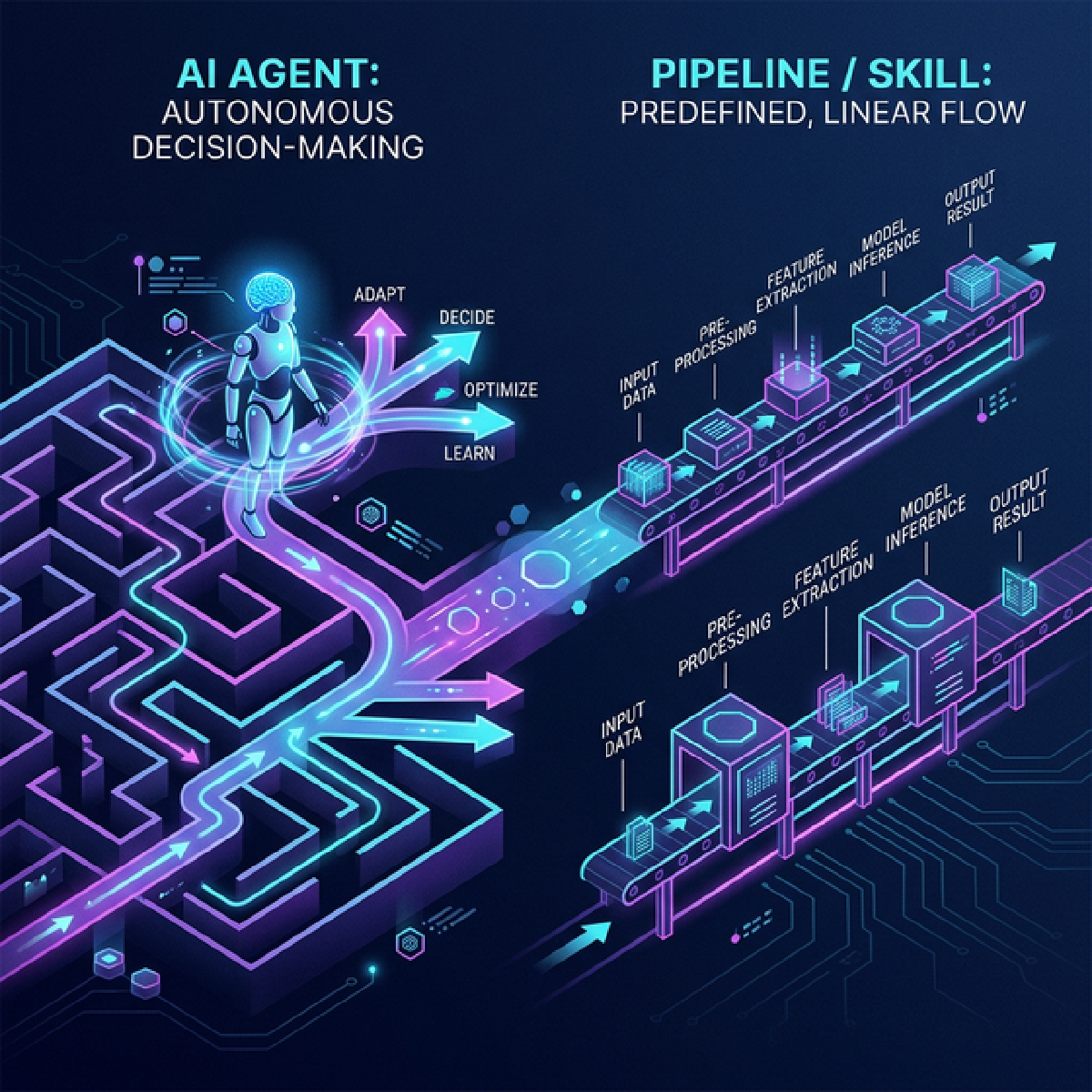
Everyone is building “agents” now. Open any product page, scroll through X, or browse GitHub trending — every other project bills itself as an AI agent. But here’s the uncomfortable question I keep asking myself:
Is your agent actually an agent, or is it just a well-dressed workflow?
After spending months working with various AI systems — building, breaking, and rebuilding them — I’ve noticed a pattern. The vast majority of so-called “agents” on the market are, in reality, deterministic workflows wearing a trench coat. They follow a fixed sequence of steps: take user input → run prompt A → parse output → run prompt B → return result.
There’s no real autonomy. No genuine decision-making. No adaptation.
And honestly? That’s not necessarily a bad thing. But we should stop calling them agents.
Anthropic’s Clarity: Workflows vs Agents#
Before we go further, let’s lean on one of the clearest frameworks available. In their influential guide Building Effective Agents, Anthropic draws a critical architectural distinction within what they call agentic systems:
- Workflows are systems where LLMs and tools are orchestrated through predefined code paths.
- Agents are systems where LLMs dynamically direct their own processes and tool usage, maintaining control over how they accomplish tasks.
This is a deceptively simple distinction, but it cuts right to the heart of the problem. Most products marketed as “agents” are actually workflows — and Anthropic is being refreshingly honest about that.
Anthropic goes further and identifies several workflow patterns that are commonly (and incorrectly) labeled as “agents”:
| Pattern | What it does | Is it an agent? |
|---|---|---|
| Prompt Chaining | Sequentially connects LLM calls, output → input | ❌ No |
| Routing | Classifies input and sends it down a fixed path | ❌ No |
| Parallelization | Runs multiple LLM calls simultaneously | ❌ No |
| Orchestrator-Workers | One LLM breaks tasks down, workers execute | ⚠️ Getting closer |
| Evaluator-Optimizer | One LLM generates, another critiques in a loop | ⚠️ Getting closer |
| True Agent | LLM dynamically decides its own actions and tool usage in a loop | ✅ Yes |
The key insight: if your system’s execution path is determined at design time by a developer (even if an LLM fills in the blanks at each step), it’s a workflow. If the LLM itself decides what to do next based on what it observes, it’s an agent.
In practice, a true agent operates in a continuous feedback loop — perceive, reason, plan, act, evaluate — where the execution path emerges at runtime, not from a developer-defined flowchart.

Three Non-Negotiable Properties of a True Agent#
Drawing from both Anthropic’s framework and the broader research literature, I’ve distilled “agentness” down to three non-negotiable properties:
1. Autonomous Decision-Making#
The system must make meaningful decisions about its own behavior at runtime — genuinely choosing which tool to use, deciding when to ask for clarification, or determining that it needs more information. A workflow says “always call search, then summarize, then format.” An agent says “do I even need to search? Are these results good enough, or should I try different terms?”
2. Dynamic Planning#
An agent constructs and modifies its plan on the fly. It decides which steps to take, in what order, and whether to change course based on intermediate results. Anthropic explicitly states: agents “can be used for open-ended problems where it’s difficult or impossible to predict the required number of steps, and where you can’t hardcode a fixed path” [1].
3. Learning from Environmental Feedback#
Within a task, an agent incorporates ground truth from its environment — tool call results, code execution output, API responses — to assess progress and adapt. If a search returns irrelevant results, it changes its query. If code fails, it reads the error and adjusts. This isn’t just error handling; it’s reflective reasoning.
Enter: Skills — Modular Expertise#
When Anthropic talks about skills, they’re not using another word for “pipeline” or “workflow.” Skills, as proposed in their Agent Skills framework and implemented in tools like Claude Code, are something more specific:
A skill is a reusable, modular package of expertise — instructions, metadata, and optional resources — that extends an agent’s capabilities without modifying its core logic.
Anthropic’s own analogy is apt: who would you want filing your taxes — a math genius figuring it out from first principles, or an experienced tax professional who’s filed thousands of returns? [6] Agents today are like that math genius: brilliant at reasoning, but lacking accumulated domain expertise. Skills bridge this gap.
Skills are defined in SKILL.md files and use progressive disclosure — at runtime, only the metadata (~50 tokens) is shown to the agent. If relevant, the full instructions (~500 tokens) are loaded. Supporting scripts and references (2,000+ tokens) load only on demand [6]. This means you can equip an agent with hundreds of skills without overwhelming its context window.
Skills don’t replace the agent — they augment it. The skill provides the what (expert knowledge), but the agent still decides the when and how.
Is a Skill Just a Complex Version of Tool Calling?#
You might be wondering: isn’t a skill just a fancier way to call tools? Not exactly.
A tool is an atomic action — search the web, execute code, read a file, call an API. It does one thing, returns a result, and that’s it. The agent decides when to use a tool, but the tool itself carries no opinion about how to approach a problem.
A skill, by contrast, is a knowledge package that shapes how the agent thinks. When an agent loads a code-review skill, it doesn’t just gain access to a “lint code” tool — it absorbs an entire framework for thinking about code quality: what to look for, how to prioritize issues, when to flag security concerns vs. style nitpicks, and how to communicate findings. The skill influences the agent’s reasoning, not just its actions.
Put differently: tools extend what an agent can do. Skills extend what an agent knows. A tool is a hammer; a skill is the carpentry knowledge that tells the agent when to use a hammer, when to use a screw instead, and why the joint needs reinforcing in the first place.
This distinction is critical. Here’s the hierarchy:
┌───────────────────────────────────────────────────┐
│                     AGENT                         │
│    (Autonomous reasoning, planning, routing)      │
│                                                   │
│  Skills (knowledge):                              │
│  ┌─────────────┐ ┌──────────┐ ┌──────────┐        │
│  │  Technical  │ │   Code   │ │  Content │        │
│  │   Writer    │ │  Review  │ │  Creator │        │
│  └─────────────┘ └──────────┘ └──────────┘        │
│                                                   │
│  Tools (actions):                                 │
│  ┌────────┐ ┌──────────┐ ┌─────────┐ ┌───────┐    │
│  │ Search │ │ Code Exec│ │ File IO │ │  API  │    │
│  └────────┘ └──────────┘ └─────────┘ └───────┘    │
│                                                   │
│  Skills shape HOW the agent thinks.               │
│  Tools define WHAT the agent can do.              │
│  The agent decides WHEN and WHY to use each.      │
└───────────────────────────────────────────────────┘
In my own project, I have skills like technical-writer, fact-checker, and content-creator — each packaged as a SKILL.md with instructions and resources. When I ask the agent to write a blog post, it loads the relevant skills and then autonomously decides how to apply them. The skills don’t dictate the execution path — the agent does.
When Should You Build a Skill Instead of an Agent?#
Here’s my practical decision framework:

Package it as a skill when:
- You have domain expertise that can be codified into instructions
- The knowledge is reusable across different tasks and contexts
- You want to augment an existing agent without rebuilding it
- The expertise involves how to think about a problem, not just what steps to follow
- You want composability — the ability to mix and match expertise
Build a workflow when:
- The task has a well-defined, fixed sequence of steps
- Predictability and consistency matter more than flexibility
- You need auditability — you must explain exactly what the system did
- The cost of failure is high — financial transactions, compliance checks
- Latency matters — workflows skip the reasoning overhead of agent loops
Build an agent when:
- The task is genuinely open-ended — there’s no single right sequence of steps
- The system needs to recover gracefully from unexpected failures
- Multi-step reasoning with dynamic branching is essential
- The system needs to use judgment about which tools and skills to apply
- You want the system to adapt its strategy based on intermediate results
So What Should You Actually Build?#
Skills and agents aren’t alternatives — they’re complementary. A skill alone does nothing; it’s expertise sitting in a folder. An agent without skills is a generalist — capable but shallow. The real question is: “Do I need an agent, or is a workflow enough?”
Anthropic’s answer: start simple.
“Success in the LLM space isn’t about building the most sophisticated system. It’s about building the right system for your needs. Start with simple prompts, optimize them with comprehensive evaluation, and add multi-step agentic systems only when simpler solutions fall short.” — Anthropic [1]
Before you call your next project an “agent,” run through this checklist:
- Does it make real decisions at runtime, or does it follow a predefined path?
- Can it change its plan based on what it observes?
- Does it reason about failure, or does it just retry?
- Does the LLM control the execution flow, or does your code?
If you answered “no” to any of these — you’ve built a workflow. And that’s perfectly fine. Workflows are the workhorses of production AI — more reliable, cheaper, faster, and easier to debug than agents. Anthropic’s own data shows that multi-agent implementations typically use 3-10x more tokens than single-agent approaches for equivalent tasks [8].
And if you have domain expertise to share? Package it as a skill. Make it modular, reusable, and composable. Skills are expertise as infrastructure — arguably the most practical contribution you can make to the AI ecosystem.
Build workflows. Package skills. And when you genuinely need autonomous reasoning, then build an agent — equipped with your battle-tested skills.
References#
[1] Anthropic. “Building Effective Agents.” Anthropic Engineering, December 2024. Link
[2] Google Cloud. “What are AI Agents?” Google Cloud AI Documentation, 2024. Link
[3] McKinsey & Company. “What are AI Agents?” McKinsey Digital, 2024. Link
[4] Stuart Russell and Peter Norvig. Artificial Intelligence: A Modern Approach. 4th Edition, Pearson, 2020.
[5] Andrew Ng. “Agentic Design Patterns in AI.” The Batch, DeepLearning.AI, 2024.
[6] Anthropic. “Building Agents with Skills: Equipping Agents for Specialized Work.” Claude Blog, 2025. Link
[7] Anthropic. “Anthropic Agent Skills.” Claude Documentation, 2025. Link
[8] Anthropic. “Building Multi-Agent Systems: When and How to Use Them.” Claude Blog, 2025. Link